
Back to the NIKA2 Run 80-81 main page
Please find the results of the preliminary data reduction at this link.
NIKA2 Re-Commissioning: NIKA2 run 80-81, Cryo run 92-93
Observers on-site: M. Sánchez, A. Bongiovanni; Remote: TBD
Rx team supporting: D. John, M. Baena
Operators on-duty: J. Santiago (day), G. Liñán (night)
Initialization files:
run92*.ini (previous sweep)
run93*.ini (new sweep)
Project: t22 PIIC plots at the start of the week: t22:~/ql_new_run92/plAr*
Preliminary plan
Task |
Done? |
Remarks |
Laser alignment test |
OK |
See notes on Sep. 30 |
Radio alignment test |
Not yet conclusive |
|
New sweep, cryo run 93 |
|
|
Check polarizer stuff |
OK |
|
First check (pointing/focus), total power, cryo run 92 |
OK |
|
First beam maps, cryo run 93, total power |
|
|
Analyze preliminary beam maps and produce DAFs/RPPs (PIIC) for all arrays |
|
|
Restore focus script to the original one |
|
|
Install the new preliminary DAFs/RPPs |
|
|
First calib_1scan on flux calibrators, more (night time) beam maps in total power, skydips |
|
|
Pointing session [use the PCCS2 catalog? see last item of this list] |
|
|
Calib_1scan on flux calibrators, night time beam maps (polarimetry), skydips |
|
|
Deep field (total power) session (t22:~/pako/202609/NIKA2_Sep26_deep.sou) |
|
|
Deep NIKA2-Pol observations on 3C286 |
|
|
Crab polarimetry scans (night time, pol-calibrations with Uranus) |
|
|
N2EDF tests (total power), project 092-26, total power, acq. rate 47 Hz |
|
|
Observing tests on Planck sources, project 093-26, total power |
|
|
Test PCCS2 pointing catalog (t22:~/pako/2PCCS2_Berta2026.sou) |
|
|
Summary tables (from 2026/09/29 to 2026/10/06)
Focus sequences
Scan nr
Target
Ar2
Ar1
Ar3
Polarized?
Notes
20260930s14-18
Mars
--
0.72
0.71
No
Starting point 1 mm. No solution for Ar2 data (high background, distorted source geometry).
s21-25
Mars
--
0.57
0.54
No
Starting point 0.72 mm. No solution for Ar2 data again.
20261001s94-98
Mars
--
1.21
1.20
No
Starting point 1 mm. Crappy solution for Ar2 data. Ar2-Ar1 ~ 0.3 mm ??
s103-107
Mars
--
1.07
1.13
No
Starting point 1 mm. No solution for Ar2 data.
s124-128
Mercury
--
1.01
1.04
No
Starting point 1 mm. No solution for Ar2 data.
s130-134
Mercury
--
1.06
1.03
No
Starting point 1 mm. No solution for Ar2 data.
s136-140
Mercury
--
1.06
0.97
No
Starting point 1.2 mm. No solution for Ar2 data. DAQ restarted after this sequence.
s142-146
Mercury
--
0.94
0.91
No
Starting point 1.2 mm. No solution for Ar2 data.
s230-234
3C84
--
1.27
1.28
No
Starting point 1.0 mm. No solution for Ar2 data.
20261002s2-6
Uranus
--
~1.8
~1.6
No
Starting point 1.3 mm. Unreliable fitting for Ar1 and 3. No solution for Ar2 data.
20261002s7-11
Uranus
--
1.42
1.41
No
Starting point 1.6 mm. No solution for Ar2 data.
20261003s111-115
Mars
~1.64
1.21
1.22
No
Starting point 1.0 mm. First focus after new RPP for Ar2. Focus on Ar2 a bit marginal.
20261003s116-120
Mars
1.59
1.25
1.24
No
Starting point 1.4 mm.
20261003s124-128
Mars
1.52
1.25
1.28
No
Starting point 1.6 mm. Instabilities growing. Wind speed rising.
20261003s129-133
Mars
1.46
(0.95)
(1.04)
No
Starting point 1.55 mm. Unreliable. Scans s129 & 130 lost, too high tracking devs.: high wind.
20261003s134-138
Mars
1.55
1.25
1.26
No
Starting point 1.6 mm. Unstable.
20261003s139-143
Mars
1.57
1.15
1.19
No
Starting point 1.6 mm. Unstable.
20261003s146-150
Mars
--
--
--
No
Starting point 1.65 mm. More unstable. Bad fittings.
20261003s156-160
3C345
1.39
0.99
--
No
Starting point 1.3 mm. Not so reliable fittings. Highly unstable.
20261005s25-29
Uranus
1.74
1.30
1.24
No
Starting point 1.0 mm. Unstable.
Beam maps
Scan Nr
Target
Focus
Polarized?
Notes
20261001s101
Mars
1.21
No
run92; ap.. size: 5.6"; @202609/beammap1scan99sub.pako; Ar1 focus used
20261001s109
Mars
1.07
No
run92; Ar1 focus adopted
20261001s110
Mars
1.37
No
run92; Ar1 focus + 0.3 mm adopted
20261002s13
Uranus
1.43
No
run92; Ar1 focus adopted
Calibrators (calib_1scan)
Scan Nr
Target
Focus
Notes
20261001s241
MWC349
1.27
run92
20261002s15
Uranus
1.43
run92
Tuesday, 29th September 2026
10:30-16:30 (LT): Dave, Marcos, Angel
- Maintenance slot included
- Cloudy and windy when we arrived. Telescope parked. Very first check: examining KIDs response change when the cryo's window is opened: OK. NIKA2 is alive.
16:30-17:45: Starting optical alignment tests. Removing M3. Checking laser imprint on M4 (configured to EMIR): the spot lies at ~22 mm from M4 center, towards the nearest wall of the cabin, as expected. The laser spot remains in that position even under rotation facing M5.
- Cryostat in level_auto, leveling 3. Table parameters: L1c = 3.16, L2c = 3.21, L3c = 3.25, L4c = 3.21; stable.
Measuring the position of the laser spot on the window cap wrt. the last reference mark used (see the pictures attached). Delta_x = -1.5 mm, Delta_y = +4 mm.

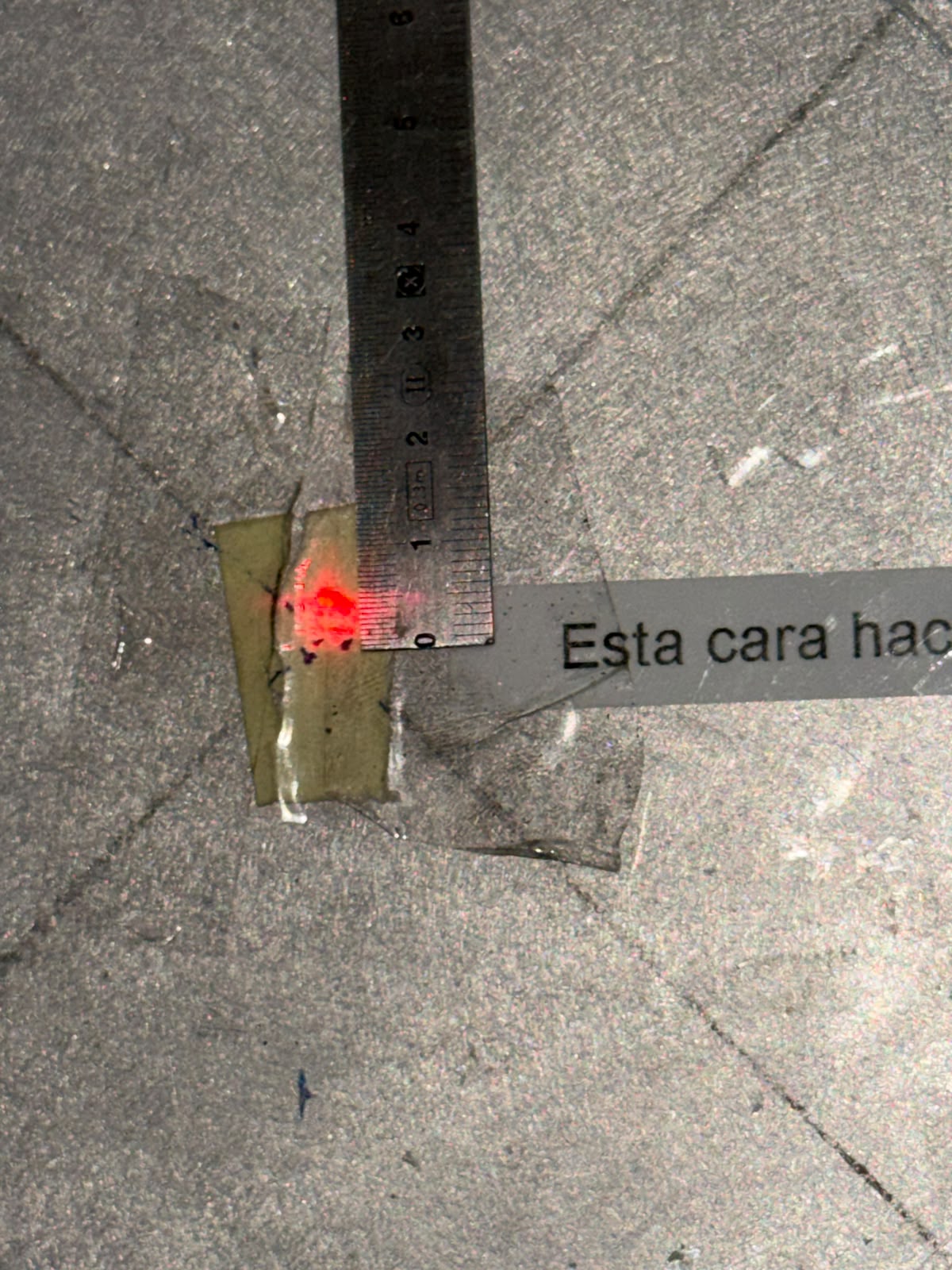
18:30-20:15: Starting radio alignment test. Rulers tangent to the window restored. Using an absorber slice of 26 x 5 cm. Taking measurements with the first reaction of the corresponding KID (see Table below). Telescope at El. 35 deg (more unstable at higher elevations), tau_225GHz ~ 0.6. Bad KIDs Ar2: 13. It's clear that atmospheric conditions are far from the required for this test:
Preliminary measurements using KIDs at the edge |
|||||
Direction |
KID nr |
KID ID |
Measurements [cm] |
Avg |
Std |
Top to Bottom |
541 |
KD043 |
18.5 18.0 18.0 18.5 18.0 |
18.2 |
0.3 |
Bottom to Top |
53 |
KA045 |
17.1 16.8 17.1 17.1 16.6 |
16.9 |
0.2 |
Right to Left |
237 |
KB039 |
18.2 17.4 17.5 17.5 17.7 |
17.7 |
0.3 |
Left to Right |
668 |
KD155 |
17.1 18.1 17.1 16.6 17.1 |
17.2 |
0.5 |
Based on that, the displacement of the polygon center is approximately (0.3, 0.7) cm (top-right corner). Surprisingly, the polygon size is 11.3 x 11.5 cm. This is considerably smaller than the previous estimation. In that opportunity, the offset was (-0.4, -1) cm: Dave and Marcos recalculated these offsets based on Mar. 31st, 2025 data.
We plan to repeat the radio alignment tomorrow morning.
After the tests with the absorber and the peripheral KIDs of Ar2, wind speed increased up to 18-19 m/s. Telescope parked.
21:00-24:00: High wind speed (max. > 20 m/s). Telescope still stopped.
Wednesday, 30th September 2026
Long T21-26 shift (03:30-17:00)
03:30-08:00 (LT): Adverse weather continues (high wind speed, tau_225GHz > 0.7). A new radio alignment test and likely a new sweep are provided in the morning.
08:00-10:50: Even with the wind speed at the limit and tau_225GHz ~ 0.6, we tried a bunch of pointings on Uranus and Mars. DAQ started (cryo run 92, total power) with bad KIDs (Ar1, Ar2, Ar3) 165, 9, 33. All arrays data appear as corrupted or with a synchro problem according PIIC-QL. Checking with Jean and Stefano. Parking the telescope after a bunch of high wind speed alarms.
11:00-12:30: A new radio alignment session, this time using a cooled (LN2) absorber:
Preliminary measurements using KIDs at the edge |
|||||
Direction |
KID nr |
KID ID |
Measurements [cm] |
Avg |
Std |
Top to Bottom |
541 |
KD043 |
20.0 21.0 21.5 21.5 20.5 |
20.9 |
0.7 |
Bottom to Top |
53 |
KA045 |
20.1 20.6 20.6 20.1 20.1 19.6 20.6 |
20.2 |
0.4 |
Right to Left |
237 |
KB039 |
18.0 20.0 20.0 20.0 19.5 20.0 |
19.6 |
0.8 |
Left to Right |
668 |
KD155 |
21.6 21.6 20.6 21.6 20.6 |
21.2 |
0.5 |
Based on that, the offset was (-0.8, 0.4) cm (top-left corner), approximately. This time, the polygon size obtained is 17.2 x 17.5 cm.
SL: Well... Not really surprising to me: remember the footprint of the beams are about this size on the window (a bit less in ray tracing, a bit more with the diffraction effects) so this is quite consistent. You got a good idea to use the relatively cold LN2 dipped absorber in front of a high T background. I think that the reason why you found a small rectangle previously when using the warm absorber is because you used it on a quite high unstable background. And since the window is very close to a pupil plane the warm signal from the absorber is diluted almost all over the image plane. So when a portion of absorber is seen by the KID, they don't see 300 K on some KID and T background elsewhere, they see an effective temperature source Teff ~ 300K*Sseen/Swindow, where Sseen is the surface of absorber entering the FOV and Swindow is the surface of the FOV on the window. As long as Teff is close to Tbkg you see no reaction on the KID signal. It's only when Teff > Tbkg+fluctuation that you really see a clear signal on the KID. That's why the procedure with absorber must be done in front of a very good sky with low opacity. With the cold absorber in front of warm background, this is the opposite, but in a regime of temperatures (so of KID response) that is further away from real observations conditions than the case warm absorber on cold background.
SL: More interesting info on alignment history, see the 2021 document History_of_optical_and_radio_alignments_of_NIKA2.pdf, and also about the radio misalignment and way to cope with it, see in particular this other document from the October 2017 pool Alignments_check_NIKA2_optics_pool1_22-10-2017.pdf.
13:00-15:00: Stefano fixed the minor issue with PIIC, thanks so much! DAQ restarted with bad KIDs (Ar1, Ar2, Ar3): 179 (Box I almost without contribution; see bullet below), 13, 59. Opacity rising again and, at times, very unstable atmosphere. Trying again on Mars for the first pointings/focus sequences. In summary:
- One of the first pointing scans (20260931s8, Mars) allowed estimating the pointing corrections for Ar2 (see the plots below). Pointing correction adopted: -5, -15.


Mars image on Ar2 exhibits a distorted footprint with two symmetrical artifacts along scan directions: projection using a KIDs mapping that is now invalid due to focal surface rescaling?? This case, a good beam map (run 92) could help to fix this. In addition, apparent mean background rms of Ar2 map competes with those of Ar1 and Ar3:


- We had the opportunity to launch a couple of focus sequences (see table above). Unable to obtain focus solution for Ar2 scans, likely due to the distorted geometry of the source. Reasonable fittings for Ar1 and 3. At ~15h opacity reached ~0.8, having thick clouds; high p2p variations in the timelines. Telescope parked after that.
- We verified that the contribution of the KIDs associated with Box I (Ar1) is missing from all the scans. Martino and Alessandro investigated this issue online (many thanks for that) after this small osberving session. In principle, the warm electronics do not appear to be responsible (all the crates were restarted for sanity); the problem likely lies with the cold amplifier or the transmission line.
SB: ohi ohi, what is happening to Ar2. Strange. I hope it's some artefact that will go away when the weather gets better and you have the opportunity to try Uranus or a QSO. I have a "bad feeling", but let's wait to have better sky.
Thursday, 1st October 2026
11:30-17:00 (LT): tau_225GHz ~ 0.55 and wind speed (max.) ~ 8 m/s at the beginning of the shift. Weather conditions are not promising.
- Starting on Mars (5.6 " app. size) for pointing/focus. From the PIIC-reduction of focus sequences, only one (ugly) fit plot appeared so far for Ar2 (20261001s94-98). See below the corresponding plots for Ar1 and 2:


- A sample of pointing scans on two blazars (3C345 and 0851+202):


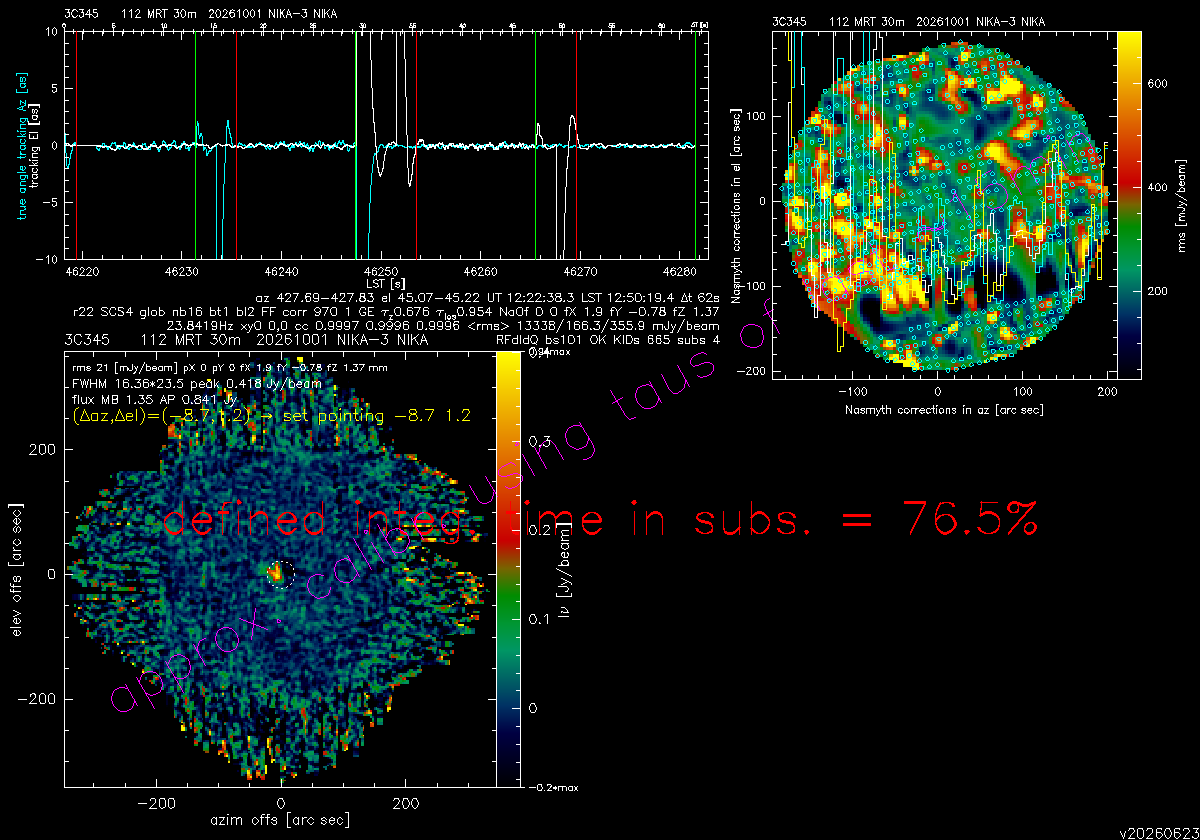


- Three beam maps (run92) launched on Mars (see table above). Conditions were mediocre for beam map standards, but they could be worse for the second part of the shift. Perhaps the first one (20261001s101) is better than the others. A first reduction can be found in t22:~/ab/beammaps_20261001.
- Opacity rising up to ~0.8. More focus sequences launched to have hints about possible Ar2-Ar1 offset. No success.
- Last hour of the shift devoted to restoring mppsync service and checking the HWP with Dave.
Friday, 2nd October 2026
00:00-03:30 (LT): tau_225GHz ~ 0.8 with large oscillations but on a downward trend, contrary to predictions. Wind speed (max.) ~ 4 m/s at the beginning of the shift. Thunderstorms towards NE. Peak-to-peak variations of the timelines at 2 mm ~ 5-10 Jy/beam along the shift.
* As in the previous shifts, we used data from Ar1 for pointing and focus corrections. Starting with pointing and focus on 3C84. Getting pointing correction on selected QSOs with varied fluxes, Uranus and MWC349. Distorted/sparsed or apparently absent source image in the Ar2 maps. So, focus correction solution for Ar2 was missing for the sequences recorded in the table above.
* To avoid overcrowding, we insert below only the pointing plots corresponding to array 2. As for the others, the maps present the expected appearance:
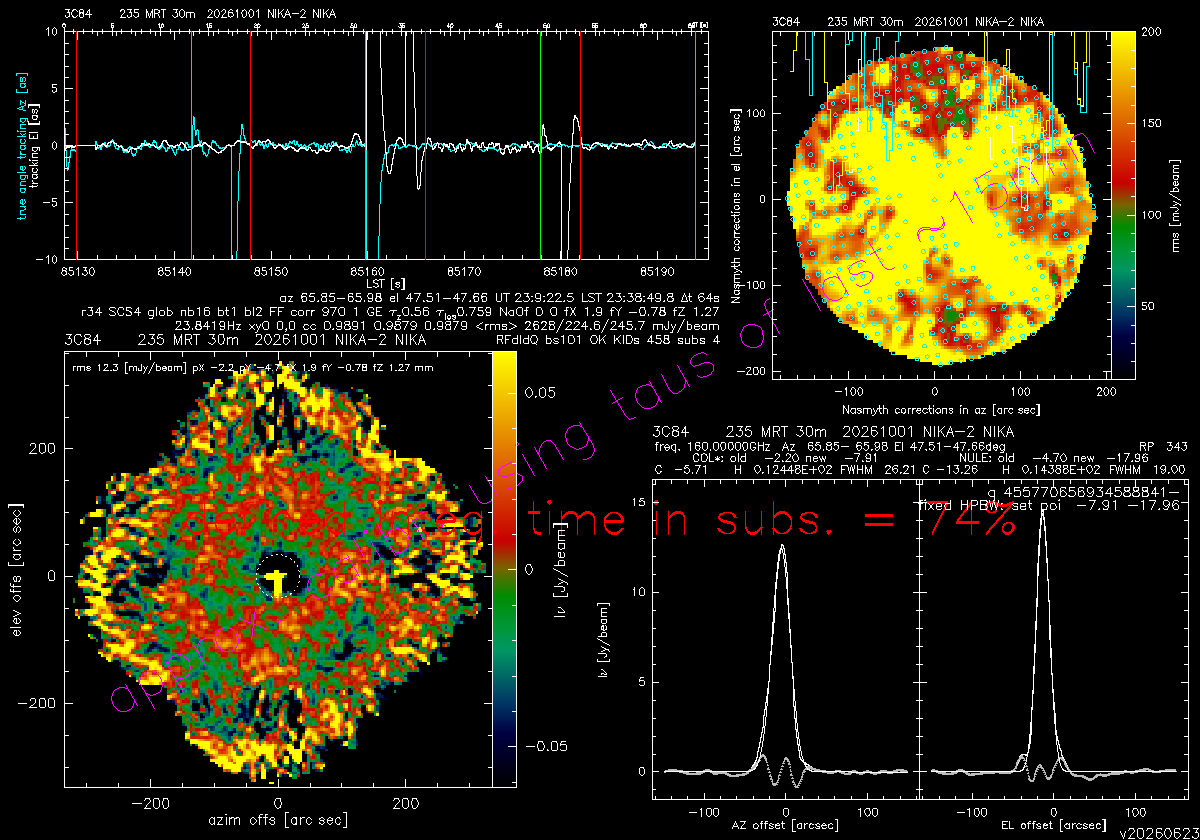


* A beam map on Uranus (run92) was launched at ~02:30 (LT) after focusing again.
* Complementarily, let's attach the Ar2 maps of calib_1scan maps on 3D84, MWC349 and Uranus:

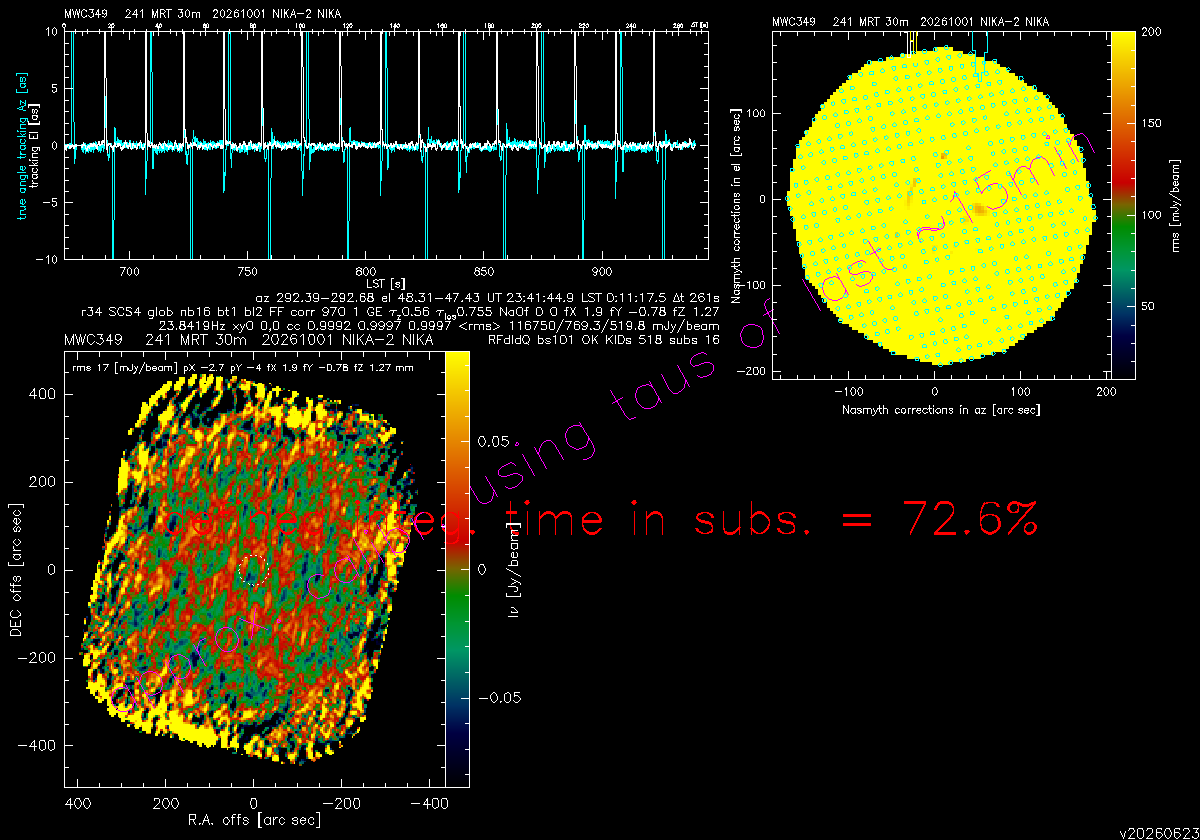

11:30-17:00: Telescope stopped since 10:10 (LT) due to high wind speed; tau_225GHz ~ 0.7 and the wind speed remains at the limit.
12:00-14:00 SB: Angel rightly suggested that with the shims on Ar2, we might have a change of scale, or something similar, and we might simply need a new set of RPPs (note that the sweep has not changed (yet), but the geometry has (because Ar2 has been physically moved)! I am now reducing the beam maps taken yesterday. Let's see if it helps. It works! Here below you see the re-rpocessed 20261001s114 Ar2 result of QL (right, obtained with the new RPP based on 20261002s13) along with the old version (left, obtained with the N2R75 RPP, see also above). Cautionary note: these new RPPs are very preliminary, because the quality of the beam maps is pretty bad. These RPPs are based on the Uranus map only (the Mars beam maps are much worse). I have not processed the beam maps of Ar1 and Ar3 yet. I will do it now, but I am not sure if they will be usable. We'll anyway need some decent ones also for Ar1 and Ar3, because I guess that the relative position between Ar1,3 and the axis of Ar2 is now changed. Thank you, Angel for figuring out the problem!!! I wonder if it's worth to try to do it for the old sweep (I mean: take more beam maps with better weather?), or if it's more convenient to go for the new sweep right away, since the old one hopefully will soon not be used anymore. The weather shall be decent enough to produce decent preliminary RPPs for the new sweep, though.

15:00-17:00: Telescope's still stopped, embedded in the clouds; light rain announced.
AB: Many thanks to Stefano for processing the beam map on Uranus and preparing the preliminary RPP for Ar2 in record time. This will allow us to move forward decisively, I think. I've reprocessed some yesterday's scans (Ar2) with the preliminary RPPs and it's working nicely. As example, the PIIC-QL plots of a pointing on 3C84 (20261001s235) and a calib_1scan on Uranus (20261002s15) are given below. Compare with their counterparts in this morning's report:


16:00 SB: I have produced also the analogous RPPs for Ar1 and Ar3 (based on 20261002s13, Uranus), but they do not work, because for some KIDs the flat field goes up to infinity (don't ask why). Therefore I have now kept the Ar1 and Ar3 RPPs of Spring. The alignemnt with respect to Ar2 is likely off, but for now it's the best we can do. Just for fun: one focus sequence in all three arrays now (scans 20261001s94-98). I'd say that it is very promising: look at the top row and not at the parabola fit! Now all we need is good weather.


AM: These are very encouraging news ! Thanks for that. I also had feared the worst. Glad to have been wrong.
SL: To illustrate why the position of each KID in the field of view (RPP) has changed, here is are screenshots of the Zemax ray tracing Layout on Array 2 in ideal case (without dichroic distortion and Ar2 at designed position, at best focus, left), and with the current 17 mm shims (at best focus assuming dichroic distortion is 1.5mm downward). The black circle represent the contour in which the KID array is inscribed (78.4 mm diameter for Ar2) ((while it's 80 mm diameter for Ar1&3)). Each color spot is a superposition of 55 crosses representing rays coming from a given direction in the sky (<=> a point source) covering a regular grid on the entrance pupil (M1); a perfect ray tracing image would appear as a single perfect cross for each color. For Ar2, the virtual circle that passes by the center of the fields that are close to the black circle represent a 6.3' diameter FOV ((for Ar1&3 the center of the fields touching the 80 mm diameter are on a 6.5' diameter FOV)). As you can see the 6.3' diameter is smaller on the 17 mm shims case than on the no shim (no trimmed mount) case. Thanks to the telecentric optical design, for a given position of the detector array, changing the focus doesn't change the FOV. But for a different position of the array, the FOV changes. Note that with the dichroic distortion downward this is better for us: the Ar2 FOV is now approaching 6.7' while in the previous case of distortion upward, the Ar2 FOV was actually a bit smaller than 6.3'. Note also that because of the displacement of the center of the membrane with respect to the ideal position, there's a grid distortion that shifts the pointing by ~5-6". Note as well that the real beams are not as distorted as the ray tracing might let you think. With diffraction, the real beams are to 1st order the convolution of the aberration spot with the diffraction spot which is bigger; ==> this convolution tells that the beam is ~95% dominated by diffraction (~ Strehl ratio).

Saturday, 3rd October 2026
11:30-17:00 (LT): Cloudy at the beginning of the shift; tau_225GHz ~ 0.6 with large oscillations, wind speed (max.) between ~10 and 13 m/s. Even so, let's check focus offsets at least, weather permitting. Continuing on run92. DAQ started at 11:50, bad KIDs (Ar1, Ar2, Ar3): 151, 8, 24.
- Starting on Mars (El. ~60 deg. and setting). PIIC-QL plots as expected for all arrays. Current deviations of pointing corrections between Ar2 and 1, after some scans: Delta_Az. ~2", Delta_El. ~12".
- Focus tests: instabilities grew from ~ +/-5 to about +/-30 Jy/beam (p2p variations of the timelines at 2 mm) during these checks. In addition, some wind gusts affected certain focus scans.
By selecting the better 4 sequences of Table above, first estimates of the focus offsets are Ar1-Ar2 = -0.33 mm, Ar3-Ar1 = -0.02 mm. As a reminder, the focus offsets before the last intervention were Ar1-Ar2 = 1.16 mm, Ar3-Ar1 = -0.08 mm. SB: awesome! I think we can go back to the old focus sequences (with standard distance in Z between scans). CK: Thanks !! This looks really promising !!
- PIIC-QL plots of (e.g.) scans 20261003s124-128:
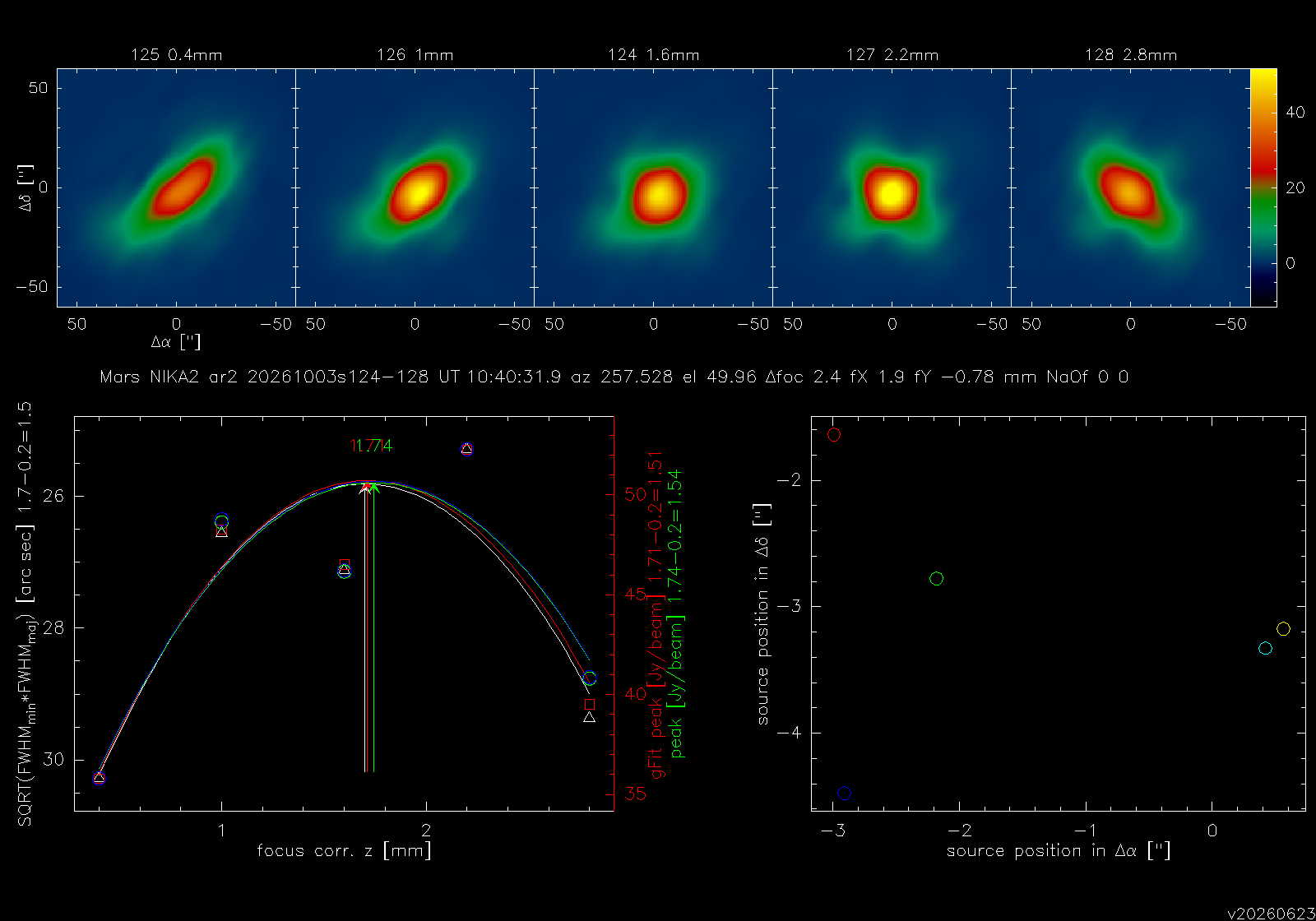


- Telescope stopped at 13:45 due to high wind speed and unstable atmosphere. Trying to observe again at 14:45. Unable to get a pointing correction/p2p vars. up to ~ +/-200 Jy/beam (!).
Sunday, 4th October 2026
11:30-17:00 (LT): Heavy clouds, tau_225GHz ~ 1, wind speed (max) > 13 m/s at the beginning of the shift. Allowed project 073-26 to continue observations of Abell 14 for ~1 hour more and reevaluate if NIKA2 tests are feasible.
12:15: Wind speed increasing, pwv > 20 mm towards North position, according to EMIR. Telescope stopped at 12:25 (LT).
16:30: Telescope remains parked. Light rain.
Monday, 5th October 2026
00:00-03:30 (LT): Telescope is parked since 23:45 due to high wind speed (max. up to 22 m/s); tau_225GHz ~ 0.7 and the forecast is not favourable.
02:30: Adverse weather continues. Telescope secure.
11:30-17:00: Telescope is parked since ~04:00 (LT), after pointing attempts using EMIR (project 073-26) proved useless. Episodes of strong winds. Very cloudy.
15:00: It has been raining lightly since noon. Max. wind speed exceeding 13 m/s since the start of the shift.
Tuesday, 6th October 2026
00:00-03:30 (LT): High wind speed (~13-18 m/s max.) and tau_225GHz ~ 1 right before the beginning of the shift.
00:15: Opacity decreased down to ~0.6, wind speed max. ~10 m/s. We decided to try some observations. DAQ started, bad KIDs counts (Ar1, Ar2, Ar3): 171, 10, 35.
* Testing a core script for azel system scanning perpendicularly to the boxes (cf. t22:~/pako/202609/test_nasm.pako) independently of elevation, facing pool project 094-26. See example scans 20261005s21 and s22: okay. The script needs to be refined to restore standard paKo services without ambiguities after use (e.g. PAKO> . /ncsServer/mrt/ncs/bin/pakoUse). Very unstable: p2p vars. up to ~ +/-100 Jy/beam at 2 mm.
* Tried some focus tests. Only the first sequence was successful. Next tries aborted due to high wind speed. Opacity rising again. Telescope parked at 01:50 (LT). Foggy and light rain later.